
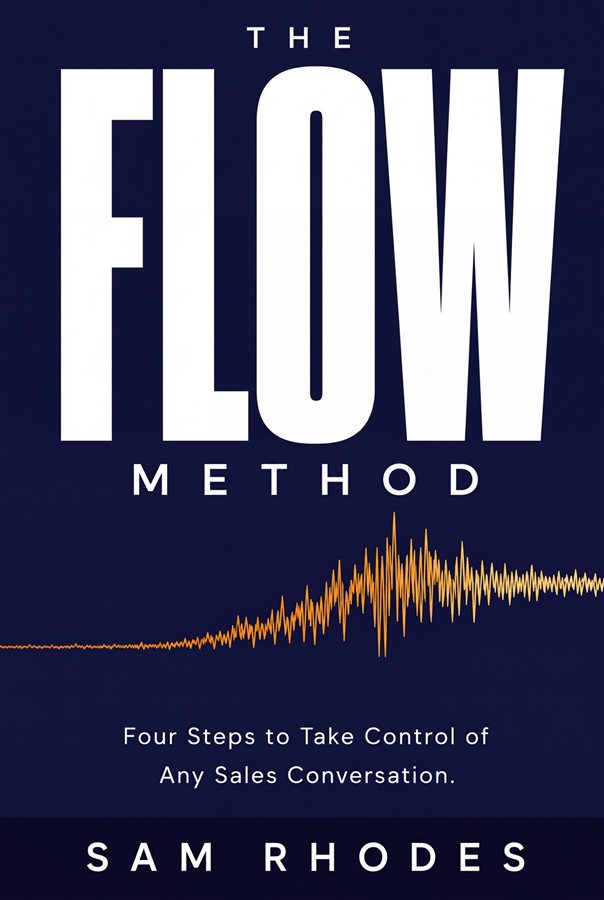
Four Steps to Take Control of Any Sales Conversation.
A sales conversation goes wrong in one of two ways. The buyer pushes back, or the buyer agrees with everything and nothing moves. Both are the same problem underneath. You are no longer deciding what happens next.
That is the only question that matters in a sales conversation, and it has an answer at every single moment. Sometimes it is you. Often it is the buyer. Occasionally it is nobody, which is the worst of the three.
Control is not volume and it is not pressure. A rep who talks for six straight minutes has not taken control of anything. Control is knowing where the conversation goes next, and having a move that puts it there.
FLOW is four moves that answer that question in your favor, run inside a single exchange rather than across a whole call.
Listen past what the buyer said to what the buyer meant. A price objection is rarely about price. Focus is the discipline of hearing the real concern under the stated one, and under drift, of hearing what the buyer has carefully not said.
Give the objection back accurately, so the buyer knows it registered. This is not agreement and it is not concession. Legitimize proves you heard the concern without conceding that it ends the conversation.
Say the buyer's situation back with something in it they did not say. Built entirely from their own material, but arranged so they recognize something new in it. Offer is judged by whether the buyer recognizes their situation, nothing else.
Ask the question that chooses the direction. Open when you need information, closed when you need a position. Under drift, the closed question does the work, because an open question hands a stalled conversation more room to stall in.
Every technique in this book has two versions, because a sales conversation has two ways of going wrong and they need opposite handling.
Resistance is the objection you can hear. The buyer names a problem, pushes on price, or stalls out loud. It announces itself.
Drift is the buyer who agrees with everything and signs nothing. There is no objection to answer, no problem to solve, and nothing to report afterward. Most sales training has no name for it.
| Move | Under resistance | Under drift |
|---|---|---|
| Focus | Listen past the stated objection to the real one | Listen for what is missing, not what is said |
| Legitimize | Validate the objection without conceding it is fatal | Validate the person, never the agreement |
| Offer | Say their situation back with something in it they did not say | State the decision in front of them, not more material |
| Work forward | Open question, to surface the unsaid | Closed question, to force a position |
Nearly every book on selling teaches open questions and generous acknowledgment as universal goods. Under drift, both make it worse.
Chapters organized across six parts.
Every chapter closes with a short assignment. Every scenario is written from both sides, what the buyer wants and what the rep can actually offer, so it converts directly into practice.
Experienced reps who have a full pipeline and can see exactly where conversations are leaking. New reps who do not yet have years of pattern recognition to fall back on, and need something more specific than advice to build rapport. Sales managers who want a shared vocabulary their team can actually be coached against.
Nothing in the book assumes a particular product, price point, or sales cycle.
The research behind the individual skills is real and it is cited. Listening, validation, and adaptive response have decades of peer reviewed evidence behind them, and the book states plainly where that evidence is strong and where it is thinner.
The FLOW method itself has never been tested as a system by any study. The book says so directly rather than implying otherwise, because a method that overstates its own evidence is not a method worth trusting on a call.
The CARE Method teaches the same underlying control for customer service conversations. The angry caller, the confused one, and the one who will not stop talking. It is a complete book for a different job, not a second half of this one.
See The CARE Method