
Four Steps to Take Control of Any Customer Service Conversation.
A service call goes wrong in one of two ways. The customer is angry, or the customer is perfectly pleasant and the call is going nowhere. One of them is loud. The other one costs you just as much.
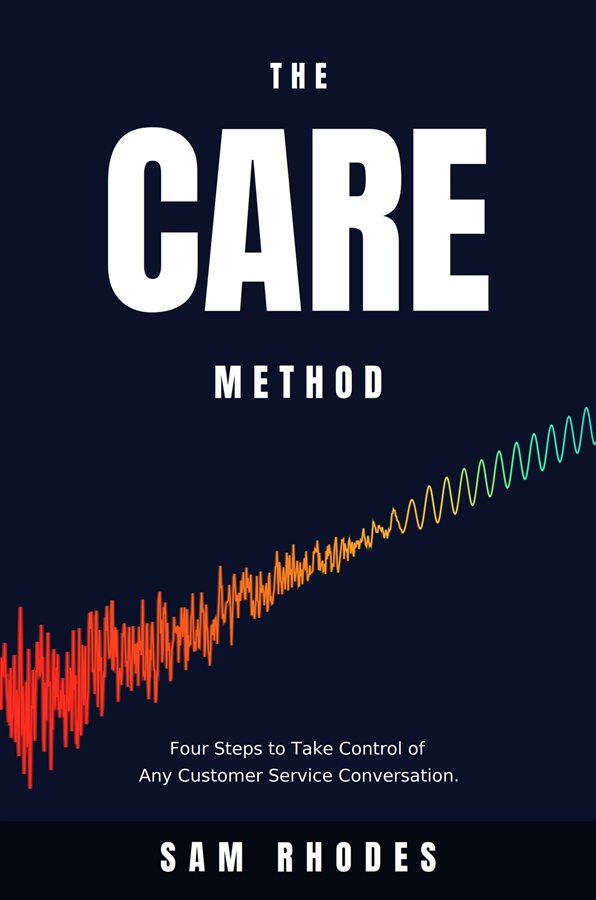
Staying calm is the advice every rep has already been given, and it has never once told anyone what to say next.
Control is deciding where the call goes instead of following wherever it leads. It is the difference between a call that ends because the issue was resolved and a call that ends because the customer eventually ran out of things to say.
CARE is four moves that put that decision back in the rep's hands, without ever making the customer feel handled.
Listen for two things at once. Under heat, the feeling underneath the facts, because customers rarely say what actually upset them. Under drift, the single fact buried in eight minutes of story.
Validate what the customer is actually experiencing. Under heat this calms the call measurably. Under drift it inverts. You validate the person rather than the topic, because validating the topic feeds it.
Answer with clarity and confidence rather than with hedging and policy language. Under drift, answer briefly and close the door behind you, because a long answer is an invitation to keep going.
Ask the question that moves toward resolution. Open questions when something has not been said. Closed questions when the call needs narrowing and landing.
Every technique in this book has two versions, because a service call has two ways of going wrong and they need opposite handling.
Heat is the call you can hear coming. The customer is angry about a charge, exhausted by the fourth call about the same issue, or suspicious of every answer. It is loud, obvious, and the failure mode every training program already covers.
Drift is the customer who is friendly and will not get to the point. There is no conflict to report and nothing went visibly wrong, which is exactly why nobody trains for it and why it never shows up in a metric.
| Move | Under heat | Under drift |
|---|---|---|
| Concentrate | Listen for the feeling underneath the facts | Listen for the one fact buried in the story |
| Acknowledge | Validate the emotion, it calms | Validate the person, not the topic |
| Respond | Answer with clarity and confidence | Answer briefly, and close the door behind you |
| Explore | Open questions, to surface what is unsaid | Closed questions, to narrow and land it |
Nearly every book on customer service teaches open questions and generous acknowledgment as universal goods. Under drift, both make it worse.
Chapters organized across four parts, one per move.
Twelve scenarios run through the book, drawn from telecom, banking, healthcare front desks, hospitality, retail, and delivery. Every one is written from both sides, what the customer wants and what the rep can actually offer.
Frontline associates taking the calls, in a contact center or at a front desk. Team leads who coach the people taking them and need something more specific than a call score to point at. Trainers building an onboarding program who want scenarios that work as role play without inventing the other half.
The research behind the individual skills is real and it is cited. Listening, validation, and adaptive response have decades of peer reviewed evidence behind them, and the book names lab studies as lab studies and correlational findings as correlational.
The CARE method itself has never been tested as a system by any study. The book says so directly, because a method that overstates its own evidence is not one worth trusting on a live call.
The FLOW Method teaches the same underlying control for sales conversations. The price objection, the hesitation, and the buyer who agrees with everything and never signs. It is a complete book for a different job.
See The FLOW Method